Custom Software Development vs Off-The-Shelf: The Real Cost Comparison

The comparison most businesses get wrong
When businesses compare custom software development against off-the-shelf solutions, they typically compare the wrong things. They look at the upfront cost of custom development against the subscription cost of an existing product, conclude that the existing product is dramatically cheaper, and buy the existing product.
Two years later, they are dealing with workarounds for features the product does not have, manual data re-entry between systems that do not integrate, staff frustration with a tool that does not match their workflow, and a vendor that has raised prices by 30% now that they are dependent on the platform.
This is not an argument that custom software is always the right answer — it frequently is not. It is an argument that the comparison needs to be done properly, not superficially.
The real costs of off-the-shelf software
Subscription costs over time
SaaS pricing looks affordable per seat per month. Over three to five years — the typical life of a software platform in a business — the cumulative cost is often significant. A £50/user/month product for 50 users costs £30,000/year. Over five years, that is £150,000 before any price increases. Enterprise SaaS pricing is typically higher and frequently rises at renewal.
This does not make SaaS expensive compared to custom development in absolute terms — but it changes the comparison. Custom software development has a higher upfront cost and a lower ongoing cost. SaaS has a lower upfront cost and a persistent ongoing cost. The crossover point depends on the specific costs involved.
Adaptation and workaround costs
No off-the-shelf product fits any business perfectly. The cost of the mismatch comes out in several ways:
- Process adaptation: Your team adapts their processes to the software rather than the software reflecting your processes. This has a real cost — both in productivity and in the competitive differentiation you give up.
- Manual workarounds: Features the product does not have get covered by manual steps, additional tools, or spreadsheets layered on top. Each workaround is a source of error and a staff time cost.
- Integration gaps: Most off-the-shelf products do not integrate with every system you use. Data that should flow automatically gets manually re-entered. The cost of this — in staff time and error rate — is often underestimated.
Switching costs
Once your business data, processes, and team habits are built around a software platform, switching is expensive. Vendor lock-in is real. The practical ability to switch vendors — even if a better option emerges, even if the vendor raises prices aggressively — is constrained by the cost of migration, retraining, and process change. This gives the vendor leverage at renewal time, which they often use.
The real costs of custom software development
Development cost
A bespoke software system costs more to develop than buying a licence to an existing one. This is true and not something to argue around. A realistic custom software project for a mid-market business typically costs £40,000–£150,000 depending on scope. Enterprise systems can cost more.
Ongoing maintenance
Custom software requires ongoing maintenance: bug fixes, security patches, dependency updates, and feature additions as your business evolves. Budget for one to two developer-days per month at minimum for a maintained production system. More if the system is actively developed.
Internal capability requirements
Custom software is most valuable when someone in the business can work with the development team to specify changes and provide requirements. If there is no internal technical ownership, the software tends to stagnate — no one is accountable for keeping it current with business needs.
A framework for making the decision
Custom development is likely the better choice when:
- The business process you are automating is genuinely differentiated — it reflects a competitive advantage or operational approach that is specific to your business
- Off-the-shelf products in the category are poor fits for your specific needs
- Integration requirements are complex and off-the-shelf products handle them poorly
- The five-year cost of SaaS subscriptions exceeds the development and maintenance cost of a custom solution
- Data ownership and portability are important to the business
Off-the-shelf is likely the better choice when:
- Your process is standard and the market has products that fit it well
- The vendor provides ongoing feature development that would be expensive to replicate
- Time to implementation is critical — custom development takes longer
- The process is not a source of competitive differentiation
The hybrid approach
Many businesses find the right answer is a hybrid: off-the-shelf for standard business functions, custom software for the processes that differentiate them. Custom software for your core operations, Xero for accounting, HubSpot for CRM, Slack for communication.
The integration between these systems — the plumbing that makes them work as a coherent whole rather than a collection of disconnected tools — is often where custom development adds the most value.
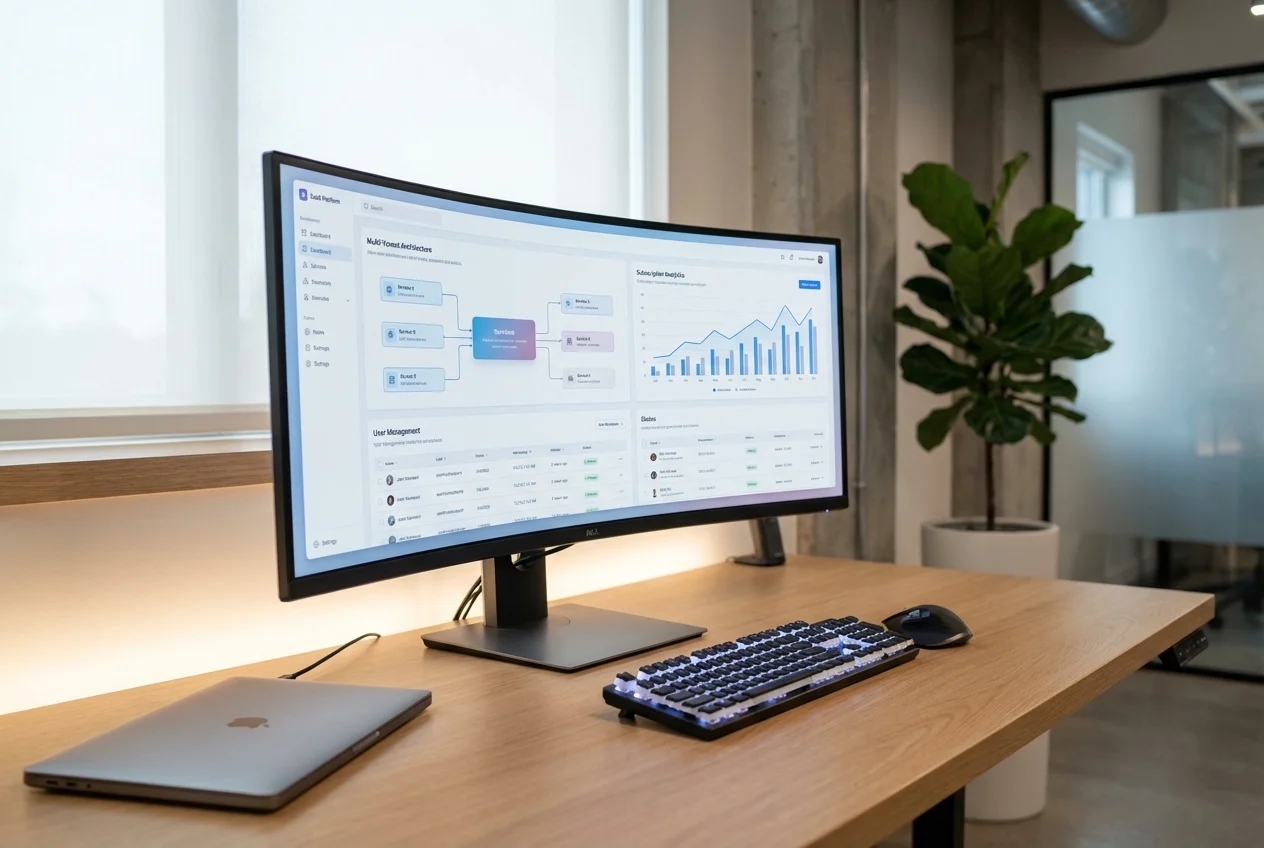 Enterprise Bespoke Development
 Enterprise Figma to Code