Bespoke Application Developers London: In-House vs Agency vs Freelance
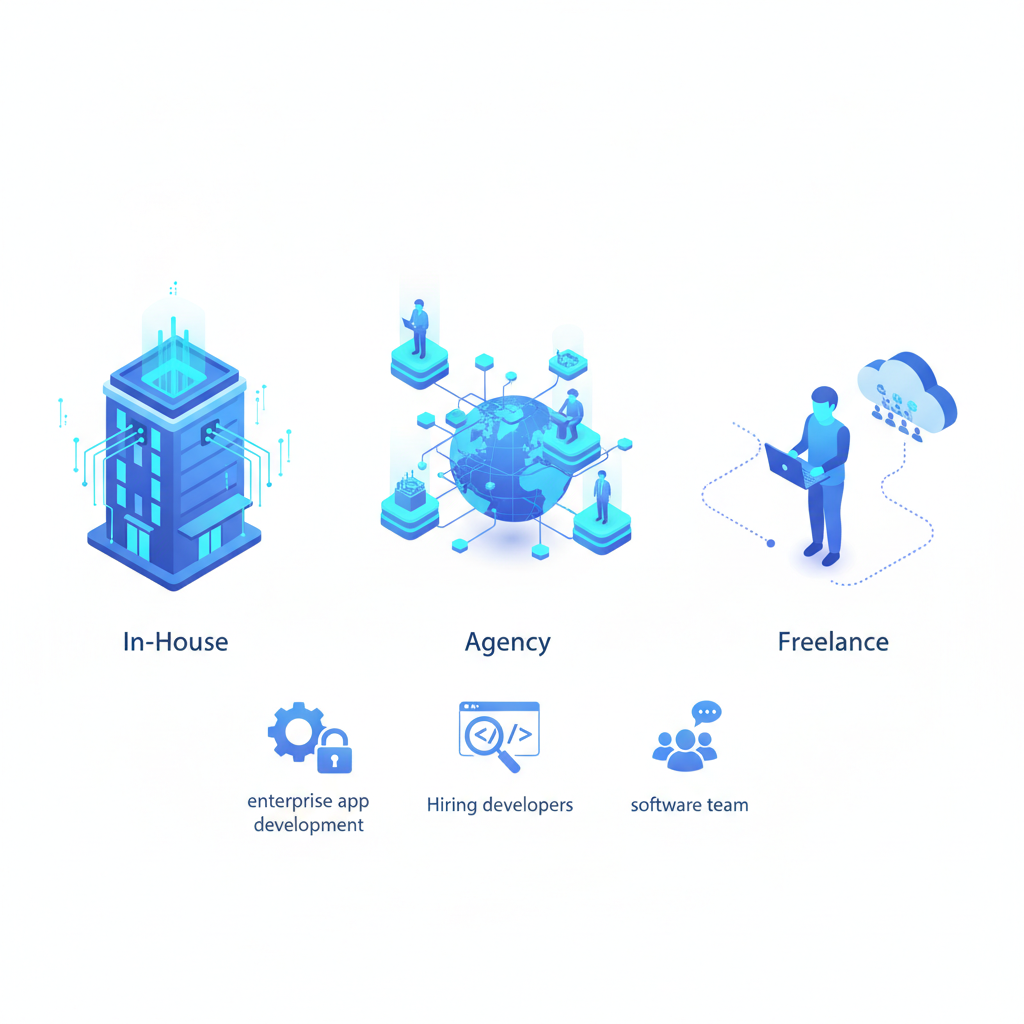
Three ways to get bespoke application developers, and why the choice matters
When a London enterprise decides it needs bespoke application developers rather than an off-the-shelf platform, the next decision is often treated as an afterthought: who actually builds it? In practice there are three distinct routes — hiring bespoke application developers in-house, engaging a freelance bespoke application developer directly, or briefing a specialist agency — and each carries a different cost structure, risk profile, and time-to-value. Getting this decision wrong is expensive in a way that is easy to underestimate at the outset: a bespoke application developer hired into the wrong model does not fail loudly, they fail slowly, through scope creep, unreviewed architecture decisions, and a system that works until it needs to change.
Hiring bespoke application developers in-house
Building an in-house team of bespoke application developers makes sense when the system you are building is core to the business long-term and will need continuous evolution for years, not a defined project with an end date. The advantage is institutional knowledge: an in-house bespoke application developer accumulates context about your business logic, your compliance history, and your prior architecture decisions that no external party retains between engagements. The disadvantage is ramp time and risk concentration — recruiting senior bespoke application developers in the London market takes three to six months at current hiring conditions, and a small in-house team has no bench strength if a key developer leaves mid-project.
Engaging a freelance bespoke app developer
A freelance bespoke app developer is usually the fastest and cheapest route to start, and it is the right choice for well-defined, single-feature work with a clear specification. Where it breaks down is on anything with real integration surface or regulatory scope: a single bespoke app developer, however capable, cannot simultaneously hold the security review, the accessibility audit, and the architecture decisions that a multi-system enterprise build requires. There is also a continuity risk — if your freelance bespoke app developer becomes unavailable mid-project, there is typically no handover process and no second person who understands the codebase.
Briefing a specialist agency
A specialist agency of bespoke application developers sits between the other two options: higher cost per day than a single freelancer, but with a named senior architect, a QA function, a security and accessibility review, and — critically — a bench of developers who can be redeployed if one becomes unavailable. For London enterprises in finance, healthcare, and legal, this model consistently produces the lowest total cost of ownership on anything beyond a single well-defined feature, because the coordination and compliance work that a freelance bespoke app developer cannot provide is exactly the work that prevents expensive rework later. Our enterprise bespoke development service and web application development service both follow this model as standard.
A simple decision framework
- Choose in-house if the system is a permanent, multi-year core capability and you can commit to a 3-6 month hiring runway.
- Choose a freelance bespoke app developer if the scope is a single, well-specified feature with no significant compliance or integration surface.
- Choose a specialist agency if the build involves regulatory compliance (FCA, NHS DSPT, ICO), multiple system integrations, or needs to ship on a fixed enterprise timeline with accountability built in.
What to ask any bespoke application developer before you commit
Regardless of which model you choose, four questions surface most of the risk before you sign anything: Who specifically architects the system, and do they stay through delivery? What does the discovery phase produce — a written specification, or just a quote? How is scope change handled once development starts? And what is the post-launch support model, agreed before, not after, launch. A bespoke application developer or team that cannot answer all four with specifics is a weaker bet than a slightly more expensive one that can. Our guide to bespoke programming and app development in London covers the discovery-phase process we use to answer these questions on every engagement, and our guide to choosing bespoke software developers covers the broader vetting framework for regulated enterprise builds.
If you are weighing in-house, freelance, and agency bespoke application developers for a specific project, book a free technical assessment with one of our senior architects. We will give you an honest read on which model fits your scope, timeline, and compliance requirements — including telling you when a freelance bespoke app developer is genuinely the right, cheaper answer.
 Enterprise Bespoke Development
 Regulated Industry Web Applications
 Enterprise System Integration